Day 82 of #100daysofnetworks
What Matters: The Thing or Its Relationships?

I am very excited to announce that today is the first day of a collaboration between #100daysofnetworks and Graph Geeks. I am collaborating with them on this project and am the current phase lead. Read more here! You can also join their Discord Server!
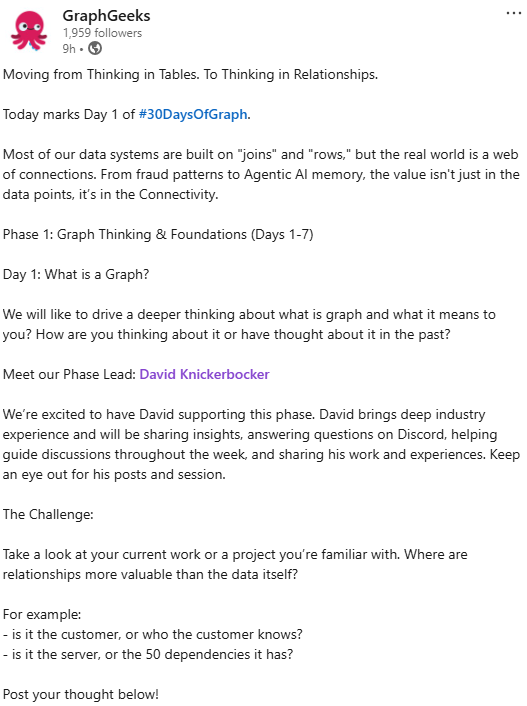
They asked a very good question today, and I want to write about it. It is a very important question, and the answer is—you guessed it—it depends.
The Challenge
Take a look at your current work or a project you are familiar with.
Ask yourself, “Where are the relationships between nodes more valuable than knowledge about the node itself?”
I’ll Answer the Question!
I am excited to answer this question, because I have had a very rich and fulfilling career, and it hasn’t only been in the tech industry.
1999 - 2012: Newspaper Writer and Web Developer
2003 - 2004: Elementary School English Teacher in Japan
2004 - 2008: Lead Programmer
2008 - 2010: Web Developer
2010 - 2013: Database Administrator
2013 - 2017: Data Operations Engineer
2017 - 2019: Data Engineer
1999 ~ : Cybersecurity Professional
2019 ~ : AI Engineer and Architect
2021 ~ : Founder and Entrepreneur
At each point in my career, I cared about different things, and different relationships between those things. I’ll try to describe some of this.
Newspaper Writer
As a newspaper writer, you should be a systems thinker. Journalists are educated to answer the journalistic questions of WHO, WHAT, WHEN, WHERE, WHY, HOW. Because I was a newspaper writer for 13 years, I always ask these questions, no matter where I work.
As a newspaper writer, I was constantly meeting people, learning about businesses, going to restaurants, going to concerts. You do a lot as a writer. You care about all kinds of things and relationships, and the relationships are often where things get interesting. Who did what, where, and when? Do you understand why I like Knowledge Graphs? :)
Elementary School Teacher
As an Elementary School Teacher, I had to create training material, and I had to teach my students. I taught at five different schools, if I remember correctly. Think about how many things and relationships are involved in teaching at five different elementary schools in two years?
You get to meet students and teachers. You get to learn who those students are friends with, and you also get to learn office politics. Office politics has more to do with relationships than things. It has a lot to do with influence, which has a lot to do with relationships.
Software Engineer
I will lump Lead Programmer and Web Developer under Software Engineer to make things easier. Many of you are software engineers of some sort. Software engineers care a lot about code and database. To be able to build anything, we need to understand how systems work together.
We care about certain things, such as databases, scripts, firewalls, coworkers, managers, and the CTO.
We also care a lot about certain relationships such as how database tables can be joined together, or whether an IP address has been classified as malicious and why, and we care about package incompatibility.
When is a relationship more important than the thing? When a package is incompatible, or when the API isn’t working, and more.
Database Developer / Database Administrator
These are two distinct jobs and should not be seen as the same thing, and there are a mountain of differences, but I’ll just keep things simple.
Database folks care about many of the same things as software engineers, but they are much more focused on the database itself and are not Software Engineers.
Database Developers create SQL code, or at least that was the job title a long time ago. They care about certain things (database tables), and how they are related (how they can be joined together).
Database Administrators care about this too, but have to deal with a lot more backend headaches, so the things and relationships they care about are at the internals level. Some of the things they care about are indexes and users. Some of the relationships they care about are user roles.
When is a relationship more important than the thing? When the file export wasn’t written. Why wasn’t it written? Oh, the upstream job failed. Why did the upstream job fail? Oh… because the server crashed. Why did the server crash? Let’s ask the Data Operations Engineers.
Data Operations Engineer
A Data Operations Engineer goes further than that of a Database Administrator, but usually does not have the database depth of a Database Administrator. Data Operations Engineers and Site Reliability Engineers (SREs) work with Database Administrators (DBAs)
My graph skills come from working in Data Operations. Nobody taught me my skills. I learned or created them out of necessity. They were created in the dataops forge. :D
Some of the things I cared about were: feeds/dataflows, files, databases, users, servers, hackers, and firewalls. Some of the relationships I cared about were user access and permissions, how database tables could be joined, what inputs created what outputs and how, root causes, and whether things run correctly.
When is a relationship more important than the thing? When the server is down. Why is the server down? Because a log file grew massive very slowly over ten years and nobody noticed. Hahahaha. True story. You deal with so many fun war stories in Data Operations. They are fun stories LATER.
Data Engineer
As a Data Engineer, some of the things I cared about were files and data feeds. I also worked with people and with different groups in the company. Some of the relationships I cared about were whether I could access data I needed to use, and the people I needed to communicate with. Data Engineers think about a lot of relationships between things.
Data Engineers even use DAGs. They are systems thinkers. They understand flow, which means they understand how things stitch together. If you only think about things, then you won’t understand how things stitch together.
When is a relationship more important than the thing? When you are doing trend analysis across a billion rows of data. In that moment, the things (files, actual data rows) matter less than their relationship with time. Another instance is when the upstream data hasn’t arrived. Why hasn’t the upstream data arrived? Oh, the upstream workflow crashed. Why did the upstream workflow crash?…
Data Engineers do large scale data transformations. If there is no data, you cannot do the transformations. If there is no downstream source, there is nowhere to put the data when you are done with it. The relationships matter a lot in Data Engineering.
I fell into Data Engineering because I am obsessed with Data Flow.
AI Engineer
As an AI Engineer, you have to understand a lot of different things, at a lot of different levels.
To build a Language Model, you have to understand how relationships in language allow for the creation of Language Models.
To create an Artificial Neural Network, you should understand what a network even is.
To understand what a network even is, you should understand the importance of both things and their relationships. If you don’t understand the importance of things and their relationships, then you can’t understand a network. You will see its behavior and maybe be able to make predictions, but you won’t understand the system.
To be an effective AI Engineer, you have to think about many different things (data, people, APIs, tokens, and the task at hand. You also have to think about many different relationships such as whether or not the data is suitable for use, how the data fits with other data, whether data is suitable for a model.
To be an effective AI and ML Engineer, you also have to understand the data itself. What is in it? What are the things? What are the relationships between those things in the data? And now in this Agentic age, AI Engineers will have to understand how agents work together.
Cyber Security
To be effective in Cyber Security, you must be a systems thinker. There is a saying that defenders think in lists and attackers think in graph, but that does not have to be the case and there is no excuse for those situations happening. It is simple to map out dataflows and infrastructure and to understand how things fit together. If you have a map of your landscape, you can protect better than if you do not.
Cyber Security professionals think about many different things such as files, servers, people, groups, IP addresses, DNS, a million things. They also care about relationships, such as what IP addresses things and files came from, whether a user has access to things, the sequence of things happening together, and more.
When is a relationship more important than the thing? When you are under attack. Where are the attacks coming from? Who is behind them? How did they get in? How do you stop it? To stop an attack, you need to understand the relationship between your defenses and the attack. When the attack meets your defenses, does it get through? Are your defenses friendly to the attack or hostile to the attack?
Founder and Entrepreneur
Since 2021, I have been building companies. You have a lot to think about when you are building companies. You have to think about things such as product, leads, revenue, cloud providers, partners, customers, a million things. You also have to think about a million relationships. It is a lot to think about, 24/7. I don’t want to write more about this right now. Hahahaha. You think about both, and it’s a lot, and it leaves you very tired, often.
When is a relationship more important than the thing? When people argue. When money is on the line. When credibility is on the line. When your future viability is at stake.
As a startup founder, you don’t just do the thing, you measure how the thing impacts reality. Do people show up and buy from you? Do they ignore you? What is the relationship between what you do and the outcome you are trying to reach? Did your behavior lead to reaching your outcome? Is it repeatable?
So, Which is More Important?
The question is where are the relationships more valuable than the thing itself. I would say that you really should think about both things and their relationships, but that it will come naturally the more you ask yourself these kinds of questions.
It is a very good and thought-provoking question, because many people have not fully unlocked systems thinking. To be a systems thinker, you have to understand the importance of both.
Neither is more important. It is situational.
So, Where Do You Start?
Graphs are complex, and they are intimidating at first. Don’t be afraid. Think of it as potential instead. You are learning to channel graphs like a mage. :D
You start at the start. That is where you should start.
In Data Science, everything starts at either Problem Definition or with an Outcome Target in mind.
So, rather than worrying too much about understanding every little thing about graphs, instead, ask yourself, “What problem am I trying to solve?”
Then figure out what things you need in order to solve that problem or reach that outcome. Then dive in. As you do the work, you will notice the important relationships.
If you would like to learn more about graph and network fundamentals, here are some resources:

I wrote this article almost three years ago to describe nodes, relationships (edges), and more.
I also wrote a book and people say it is good.
Have a Great Time!
I recommend really making use of Graph Geeks’ 30 day challenge, if you are interested in learning about graphs and have time to spare. Graph learning is complex, and the learning will only be surface level unless you do the work.
I recommend:
Create your own repo
Do what I do on my blog. I have written 82 articles.
Have a great weekend! Join the Graph Geeks Discord Server!
Last and unrelated to this article: the discount on API access ends today, and I will reach out to paying subscribers to onboard them tomorrow. The offer ends tonight at midnight. I don’t want to talk about it in this article, I just want to mention that I have begun onboarding API users, and will be onboarding paying subscribers starting tomorrow.