
Day 75 of 100daysofnetworks
The Verdant Eye is Online: World‑Aware AI Arrives

Hi everybody! I’m excited to write today’s article, and I’m pleased to see that this is on day 75, a nice milestone day. As always, I have updates. This week, I have been working very hard on building and tuning the Verdant Eye GraphRAG AI interface.
This is a world-awareness interface.
You can ask it about all kinds of things, and you will be given information about those things. This is a source for Agentic AI, and it is also very useful for human analysts.
My Agentic Future
In the future that I envision, humans will be SERVED by AI Agents. They will look after our wellbeing and our interests, and they will be reliable. In this future, my own agent would constantly probe the real world for:
Dangers and frustrations to avoid
Opportunities for me to capture
Events that I might want to go to that will bring me joy, happiness
Things that I might want to learn about that will bring me fulfillment
People that I might want to be introduced to
Shortcuts to where I am trying to go
Interesting stops that make a trip more enjoyable, in real-time (“hey David, this place you are about to drive past is world famous for <something>, and it just so happens that <something> is one of your favorite foods and it’s almost lunch time, so…”)
And on
And on
And on (use your imagination, please).
To me, the agentic future is a future where AI does useful things for us, not a world where we are obligated to use Agents otherwise we will be left behind. This stuff should serve us.
So, I’m building platforms to enable that.
Verdant Eye AI API Online
Last week, I brought GrooveSeeker AI online (event intelligence, fun things to go to and enjoy life), and this week I have brought the Verdant Eye online (world awareness; things happening). In other words, one is events and the other is happenings. They are not the same thing. Both are awareness. Verdant Eye is very high level, and GrooveSeeker is street level.
Yesterday, I completed testing for the Verdant Eye GraphRAG. It passed all of my tests, and then I deployed it as a Chat Interface, which also put it behind an accessible API. Today, I’ll show a little of both.
Any software developer on Earth can get access if they buy access. I am pricing this for individuals and small businesses, so that I can empower citizen scientists, entrepreneurs, those who want to find their own creative freedom, and small businesses. I have API keys available, and early access is opening.
I will also occasionally give away promotional keys. Maybe I’ll do a hackathon, or put out a challenge, like I used to do for my book. This isn’t a hobby or a toy. This is an incredibly powerful OSINT tool, and you can build platforms of the future with it.
Show and Tell
This API is different than the GrooveSeeker API. The GrooveSeeker API outputs event information that matches a prompt. If someone asked about Jazz events, they’d see a list of jazz events.
The Verdant Eye is intended to be used by Agents and data professionals who are comfortable working with an API. You pass it a natural language prompt or question (“What is happening in Minneapolis?”) and you get a dataset in return.
This is the way that I envision Agentic communication will happen, and it is transparent and scalable. It would be simple for me to fire off a few hundred agents to keep an eye on every city in the world, in natural language, this way.
And this is a GraphRAG, so it has network thinking by design. If you want to ask it what two people or two groups have in common, you can. What does politician A have in common with country B? What is the overlap?
Or, you could do narrative analysis, and actually get to know the 6D chess game better for yourself, and see it unfold in real time, if you acquire those skills.
Anyway, there is a lot that you can do with this, so I will stop introducing it and show a couple screenshots. It takes one line of code to connect with the API, and then one line of code to make calls to it. If you can write two lines of code, your AI can have real-time real-world awareness.
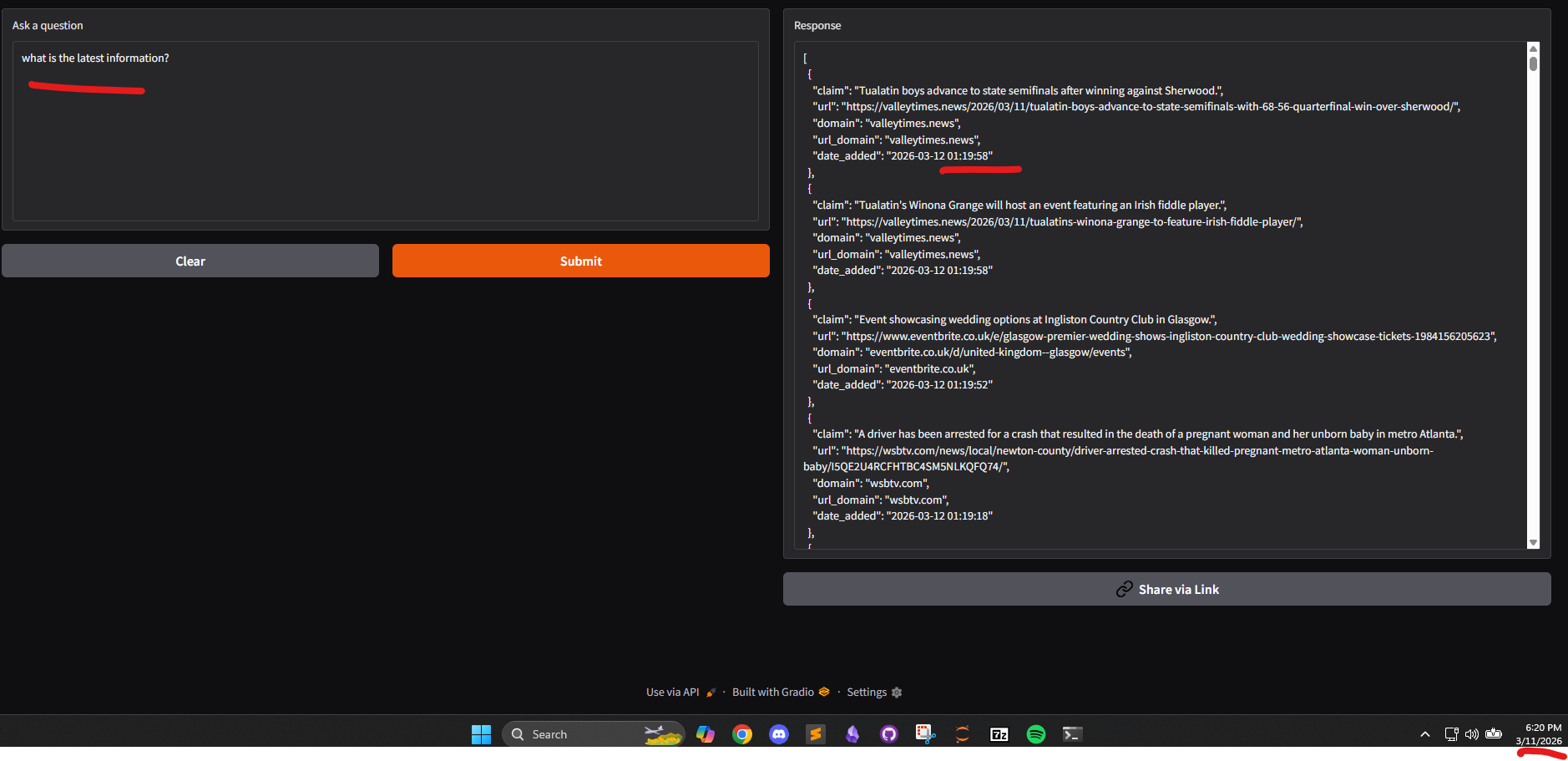
First, there’s no point claiming to have real-time AI if you can’t back it up.
Prompt: “what is the latest information”
Output timestamp: 2026-03-12 01:19:58
The data is fresh. It arrived in the database less than a minute ago. That’s just crazy. What’s the latest information? Can literally see data from a second ago if you hit the API at the right moment. :D
This is what living system data looks like. This isn’t hourly batch. This is always on. This is what it looks like when AI has space-and-time awareness.
Let’s do something more interesting than “what is the latest information.” This is OSINT AI, space-and-time aware. My Living Library of Knowledge (LLK) is Space and Time Context of the World.
If you can write code like this, you can do OSINT.
answers = []

questions = [
    'Microsoft in 2026',
    'what happened related to microsoft in the last month?',
    'what happened related to openai in the last week?',
    'what happened in Texas yesterday?',
    'what happened in Oregon in February 2026?',
    'what events and concerts have happened?'
]

for question in questions:

    print(question)
    print()
    %time answer = ask_verdanteye(client, question)
    print('answer length: {}'.format(len(answer)))
    print()
    answers.append(ast.literal_eval(answer))

answers
This is about as simple of code as it gets.
You write a question in your own natural language
You send your question to my API
You get data back about things that happened in the physical world
So, when I ran the above code, I got this output:
Microsoft in 2026

CPU times: total: 1.33 s
Wall time: 2.19 s
answer length: 5398

what happened related to microsoft in the last month?

CPU times: total: 1.27 s
Wall time: 2.2 s
answer length: 3107

what happened related to openai in the last week?

CPU times: total: 1.36 s
Wall time: 2.16 s
answer length: 3432

what happened in Texas yesterday?

CPU times: total: 1.52 s
Wall time: 2.45 s
answer length: 39740

what happened in Oregon in February 2026?

CPU times: total: 1.44 s
Wall time: 2.71 s
answer length: 827937

what events and concerts have happened?

CPU times: total: 2.16 s
Wall time: 5.04 s
answer length: 2880414
You can see the kinds of questions that can be asked. I can ask about things happening yesterday, last week, last month, last year. I can filter regionally and topically. It takes less than 5 seconds to get a lot of useful real world data.
My AI interfaces are space and time aware, and yours can be too.
That’s all I’m going to show for today. We will play with the data in upcoming articles. API access is opening, and any paying subscribers who become paying subscribers before 3/20/2026 will get $100/month API access for $8/month and will keep it for as long as they are paying subscribers.

I mentioned the limited time offer in the previous article.
What’s Next?
Today is day one of a new world for me. I have world aware AI, and I get answers very quickly. Now I get to use it to build whatever platforms of the future that I want to build, and I’m excited for others to integrate with my platforms and do the same.
But this is a big day for me! I erased my entire whiteboard! I started down this journey towards world-aware AI a long time ago—years ago if I think about it. But I started actually building my own implementation of it in October 2025, and now it is here.
That means that I get to flip a switch in my mind. I’ve built the thing that I wanted to build, and now I get to enjoy this new future. I get to play in the world where I have realtime AI that gives me useful information.
So, here are some of the things that I want to do next:
Now I have a solid foundation for Agentic AI work. I want to build off of that.
Several exciting collaborations are beginning, and I’m excited to work on them.
This API enables OSINT with AI, so now would be a good time for me to start writing more about OSINT, and doing collaborations with those who do OSINT training. I am also happy to collaborate with people who do actual OSINT investigations, as I have a powerful API that can help you. :)
This API enables temporal ecosystems analysis. Did the punk rock ecosystem grow or shrink in 2026? What’s your bet? Want to do the analysis? Know how? Now you can. Don’t know how? Read days 1-60.
This API enables temporal ecosystems analysis. Who is winning narrative battles?: conspiracy theorists or mainstream media? What’s your bet? What is the impact that this has had on society? How would you know? How would you analyze that? You now can.
This API enables Natural Language Processing (NLP) research. Have narratives around a topic changed over time? Do you know how to research this? Now you can plug in and do the analysis without having to figure out software engineering, web crawling, APIs, and servers.
So, for a creative person like me, I just gave myself the ultimate gift. I can research anything, and I can go as deep as I want and am skilled enough to do so.
This just poured gallons of rocket fuel on 100daysofnetworks and lit a match. Can’t wait to see and hear about what paying subscribers research with this tool. Also can’t wait to see what skilled Agentic AI engineers do with this new world awareness. You are no longer limited by web search. With this, you tap into the heartbeat of the internet itself.
What else can I say? It’s built. Now I get to enjoy it. My new world is here.
I am looking forward to seeing what builders of the future will do with this.
Ways to Support This Blog
I have been writing this series alone for a long time by now. I can’t imagine stopping. I love this subject, and I love what these techniques empower me to be able to do. I also love the interactions that I have with people, through this blog. It has led to friendships, businesses, collaborations, books, many things.
If you would like to support this work and research, here are some ways:
Subscribe to this Blog: Free subscribers keep me motivated. It is easy to keep writing when things continue to grow. If things move in the opposite direction, it is discouraging. Please subscribe and keep this growing, so that I will stay motivated to keep writing, which will help myself and others keep learning.
Upgrade your Subscription: If you are subscribing, please consider upgrading to a paid subscription. Paid subscribers are enabling this blog’s AI research (Graph Databases, Knowledge Graphs, GraphRAG), and a few subscribers are accessing the Artificial Life Research Knowledge Graph that was built through this blog. Special thank you to all paying subscribers. I am working on ways to bring more value to you, with this blog.
Read my book to understand how I think: You can buy my book here! In my book, I explained the importance of the marriage of Language and Graphs in my book before LLMs were invented, before GraphRAG was a thing. This has been obvious to me for a long time, and I have explained the importance through this blog as well.
Use my Platforms and Data: Build new applications, platforms, and companies! We are looking for users and partners, and we are pricing things for individuals, citizen scientists, and small businesses. We want to support those who are left behind, and we are doing it. We want to empower EVERYONE in the AI Age.
Spread the Word: Tell your friends about this blog and my websites (GrooveSeeker, Verdant Intelligence, share my LinkedIn posts). It takes very little effort to share my research and work and it will have a big impact.
Use my Websites: Use GrooveSeeker to find things to enjoy. Visit Verdant Intelligence to learn more about what I have built and how it can be used.
Let’s do Business Together! Use Verdant Intelligence! We are stronger together! I have worked in data my entire career and I’m sure I can help you. I am available for consulting and project work, and my platform is available for access.
“This API enables OSINT with AI, so now would be a good time for me to start writing more about OSINT, and doing collaborations with those who do OSINT training. I am also happy to collaborate with people who do actual OSINT investigations, as I have a powerful API that can help you. :)”
so awesome! would love to see you collab with a few other osint’rs!